Decision Trees for Classification
Machine Learning
AI Engineering
Using Decision Trees for Classification Tasks
Estimated reading time: ~10 minutes
Decision Trees for Classification
Objectives
- Develop a classification model using Decision Tree Algorithm
- Apply Decision Tree classification on a real world dataset
Introduction
This article explores decision tree classification, a machine learning technique for making data-driven decisions. We build, visualize, and evaluate decision trees using a real-world dataset for drug prediction based on health parameters.
Importing Libraries
import numpy as np
import pandas as pd
from matplotlib import pyplot as plt
from sklearn.preprocessing import LabelEncoder
from sklearn.model_selection import train_test_split
from sklearn.tree import DecisionTreeClassifier, plot_tree
from sklearn import metrics
%matplotlib inline
import warnings
warnings.filterwarnings('ignore')
About the dataset
The dataset contains patient health parameters and the drug each patient responded to. Features include Age, Sex, Blood Pressure, and Cholesterol. The target is the drug prescribed.
Downloading the Data
path= 'https://cf-courses-data.s3.us.cloud-object-storage.appdomain.cloud/IBMDeveloperSkillsNetwork-ML0101EN-SkillsNetwork/labs/Module%203/data/drug200.csv'
my_data = pd.read_csv(path)
my_data.head()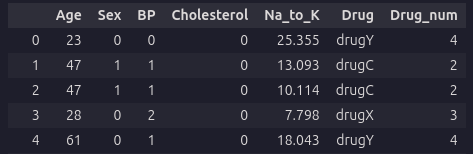
Data Analysis and Pre-processing
my_data.info()
label_encoder = LabelEncoder()
my_data['Sex'] = label_encoder.fit_transform(my_data['Sex'])
my_data['BP'] = label_encoder.fit_transform(my_data['BP'])
my_data['Cholesterol'] = label_encoder.fit_transform(my_data['Cholesterol'])
my_data.isnull().sum()
custom_map = {'drugA':0,'drugB':1,'drugC':2,'drugX':3,'drugY':4}
my_data['Drug_num'] = my_data['Drug'].map(custom_map)
my_data.drop('Drug', axis=1).corr()['Drug_num']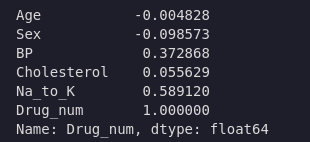
category_counts = my_data['Drug'].value_counts()

# Plot the count plot
plt.bar(category_counts.index, category_counts.values, color='blue')
plt.xlabel('Drug')
plt.ylabel('Count')
plt.title('Category Distribution')
plt.xticks(rotation=45)  # Rotate labels for better readability if needed
plt.show()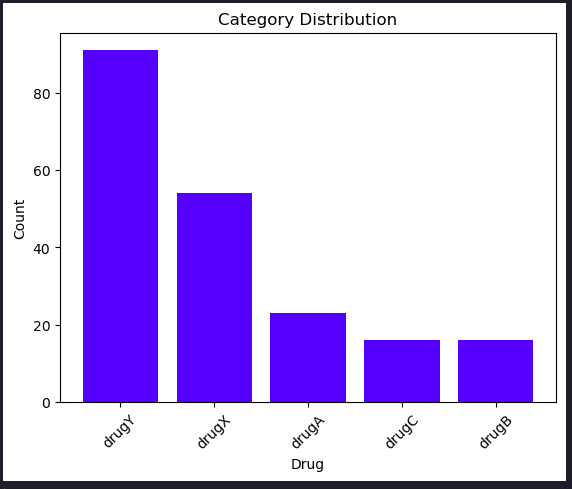
Modeling
y = my_data['Drug']
X = my_data.drop(['Drug','Drug_num'], axis=1)
X_trainset, X_testset, y_trainset, y_testset = train_test_split(X, y, test_size=0.3, random_state=32)
drugTree = DecisionTreeClassifier(criterion="entropy", max_depth = 4)
drugTree.fit(X_trainset,y_trainset)
Evaluation
tree_predictions = drugTree.predict(X_testset)
print("Decision Trees's Accuracy: ", metrics.accuracy_score(y_testset, tree_predictions))
Decision Trees’s Accuracy: 0.9833333333333333
Visualize the tree
plot_tree(drugTree)
plt.show()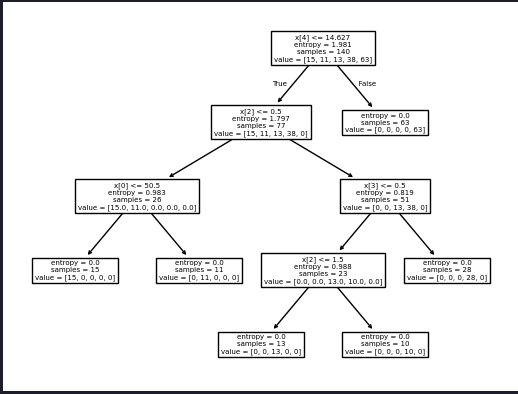
Practice: Shallower Tree
shallow_tree = DecisionTreeClassifier(criterion="entropy", max_depth=3)
shallow_tree.fit(X_trainset, y_trainset)
shallow_preds = shallow_tree.predict(X_testset)
print("Decision Tree (max_depth=3) Accuracy:", metrics.accuracy_score(y_testset, shallow_preds))
Decision Tree (max_depth=3) Accuracy: 0.8166666666666667
Summary
This article demonstrated how to build and evaluate a decision tree classifier for drug prediction, including data preprocessing, model training, evaluation, and visualization.